Dental Implants

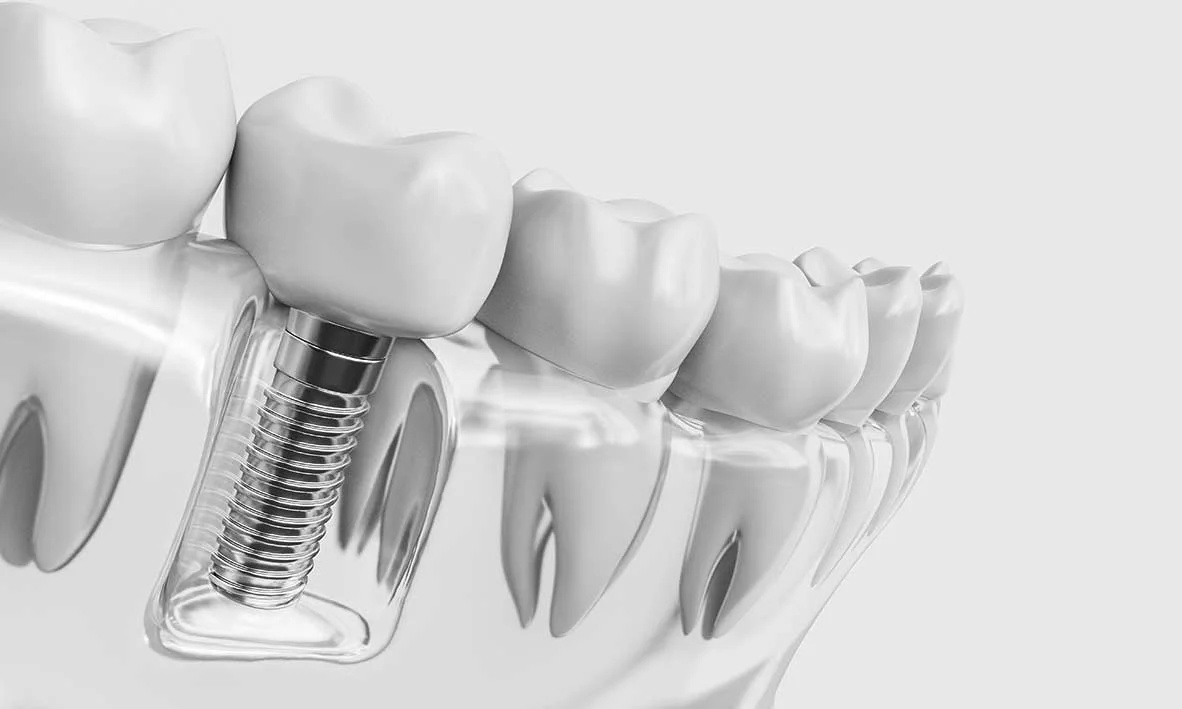
A dental implant is used in place of a missing tooth, or set of teeth, using a biocompatible titanium screw. The screw sits in place of where the missing tooth’s roots were and has a crown/ bridge (artificial tooth) attached to the top of it.
Over time, bone grows around the implant, which helps to hold it in place long-term. Each crown that is attached to the screw is specially designed to look like your other teeth. This is achieved by matching the size, shape and colour of your other teeth.
Dental implants are also used to hold a dental bridge or dentures in place.

Implants Suitability

The procedure

This specialist procedure is performed with the use of magnifying loupes or microscopy and additional surgical lights. Surgical miniaturised dental instruments are also used.

Placement

Removal of the damaged tooth by atraumatic tooth extraction surgery or, in the instance of no tooth, the gum is surgically incised to allow the preparation of the bone and place the implant.
The implant is fitted into the jawbone and covered while the bone fuses to the implant via a process known as the osseointegration.

Crown

Several months later, following osseointegration, a second operation may be required to uncover the top of the implant and connecting an abutment to the implant that is integrated in the bone.
Finally, the crown or bridge is fitted.

FAQs

No. While the procedure takes place you will be under the appropriate level of pain management and sedation. After the surgery, mild discomfort is controlled with conventional pain medication. In case of implant placement with simultaneous advanced bone augmentation, the procedure is carried out under sedation or with the use of happy gas which often provide favourable relief in both pain and anxiety.

In most cases, yes. Bone grafting is now a routinely performed treatment in order to promote bone grow and allowing for a dental implant.

Recent studies indicate dental implants can last from 10 to 30 years without performance issues. Regular and very careful care is required to maintain dental implants and additional chair-side time and maintenance costs may be needed after some years of function.

The crown attached to the screw from your implant requires regular maintenance, just like regular teeth. However, their demand for attendance is higher than your natural teeth. If well-treated cases, they are very successful and have long longevity. Yet, if not appropriately cared for, they are subjective to Peri-implant Diseases and often deteriorate at a mach faster rate than natural dentition. Regular dental visits are recommended 2-4 times per year to maintain great hygiene. Careful and consistent home oral hygiene including interdental brushing is essential for the long-term function of dental implants.

Specialist Clinical Expertise

Based on Research & Clinical Experience

Professor Quaranta is a world authority in the field of dental Implantology.Over the years, he has developed an extensive expertise and leadership in clinical research and specialist practice.

Together with his Clinical Research Team, he has successfully practised the dental implant treatments for years and is one of the pioneering in leading the new and ever-evolving concepts of contemporary Implant Dentistry.

This has resulted in the publication of numerous articles on top-rank.

Scientific journals and invitations as speaker on implant dentistry by several scientific societies, universities and dental study clubs, in both national and international occasions.

For more information about it please see the Media page

 
Any surgical or invasive procedure carries risks. Before proceeding with a surgical or invasive procedure, you should seek opinion from an appropriately qualified health practitioner.
Prof Alessandro (Alex) Quaranta
Specialist Periodontist · Clinical Professor, University of Sydney · PhD, MRACDS, FRACDS
This information is provided by Prof Alessandro (Alex) Quaranta, an AHPRA-registered Specialist Periodontist, Clinical Professor of Periodontics and author of 200+ scientific publications. Read Prof Quaranta's full profile.

Dental Implants — FAQs

What is a dental implant?
A dental implant is a titanium or ceramic post placed into the jaw to replace the root of a missing tooth. After it integrates with the bone it supports a crown, bridge or denture that looks and functions like a natural tooth.
Am I suitable for dental implants?
Most people with a missing tooth are candidates, provided there is enough healthy bone and the gums are free of active disease. Where bone is deficient, bone grafting can rebuild the site. Prof Alex Quaranta assesses your gum health, bone volume and general health to plan a predictable result.
How successful are dental implants?
Implants have well-documented, high long-term success rates in healthy, well-maintained patients. As a Clinical Professor and researcher in periodontics and implantology, Prof Quaranta plans each case around the evidence to maximise long-term stability.
Where does Prof Quaranta place dental implants?
Prof Alex Quaranta provides specialist implant and periodontal care at Smile Specialists Suite in Neutral Bay (Sydney) and Newcastle, as well as Kiama Dental Specialists in New South Wales.
Do I need a bone graft before an implant?
Only if there isn't enough bone to support the implant. Where bone has been lost through missing teeth, gum disease or injury, a graft can rebuild the area first. Prof Quaranta will confirm whether grafting is needed as part of your assessment.

Related treatments & information